


ESTA ES LA IMAGEN Y SITIO - ABAJO EN ESTA ENTRADA- QUE EN LA ANTERIOR EDICIÓN Y REPORTE DIARIO DE SPACE WEATHER, AYER 23 DE OCTUBRE (AUNQUE HOY EN AMÉRICA ES 24 DE OCTUBRE EL DESFASE DE LAS FECHAS NUNCA LO HE ENTENDIDO EN ESTE SITIO DE SPACEWEATHER) PERO FUE AYER!, SE SUPRIMIÓ ESTA PARTE DONDE MENCIONA DE UN ASTRONOMO TAILANDES AFICIONADO QUE DESCUBRIÓ ESTE REGISTRO EN "EL CORONOGRAFO" DE LA NASA PARA TAL FIN DE RASTREAR EL MOVIMIENTO DEL COMETA ATLAS... VER AQUI:

This is an AI Free Zone: Text created by Large Language Models is spreading across the Internet. It's well-written, but frequently inaccurate. If you find a mistake on Spaceweather.com, rest assured it was made by a real human being. |  |
 |
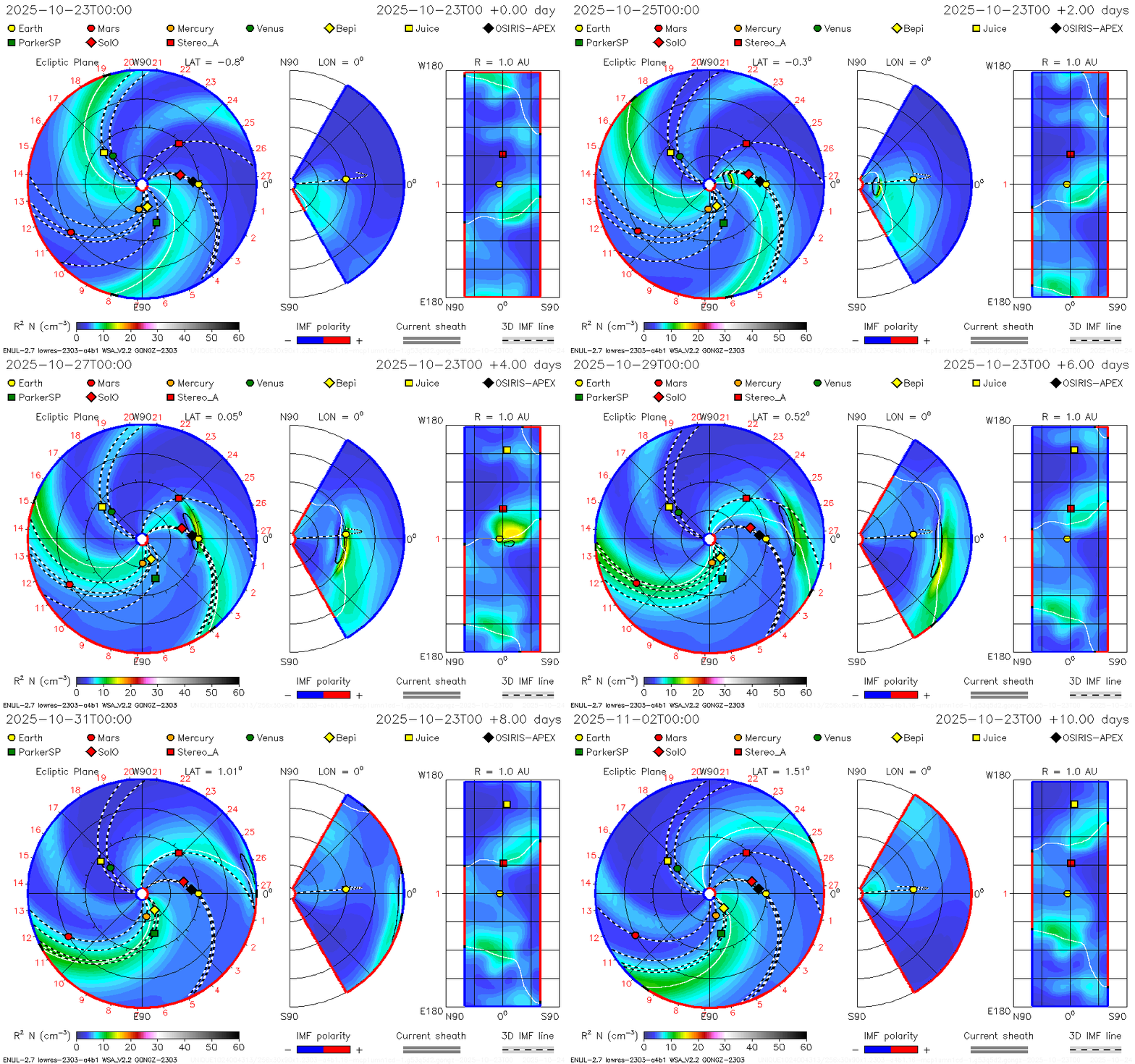
POSSIBLE EARTH-DIRECTED CME: A CME that left the sun during the late hours of Oct. 23rd might reach Earth this weekend. NASA models suggest a direct hit on Oct. 26/27, bringing a chance of minor G1-class geomagnetic storms. This is a low confidence forecast. Several overlapping CMEs left the sun on Oct 23rd, and they were tricky to untangle. CME impact alerts: SMS Text.
COMET 3I/ATLAS IS NOT HIDING FROM EARTH: This week the internet is buzzing with headlines like "Mysterious Object Is Up to No Good While It’s Hidden Behind the Sun." They're referring to interstellar Comet 3I/ATLAS. Harvard astronomer Avi Loeb and others have suggested it might be a spaceship deliberately hiding from humans. There's just one problem with this argument: We can still see it from Earth.
For example, the CCOR-1 coronagraph onboard NOAA's GOES-19 satellite is tracking the comet and monitoring its brightness:
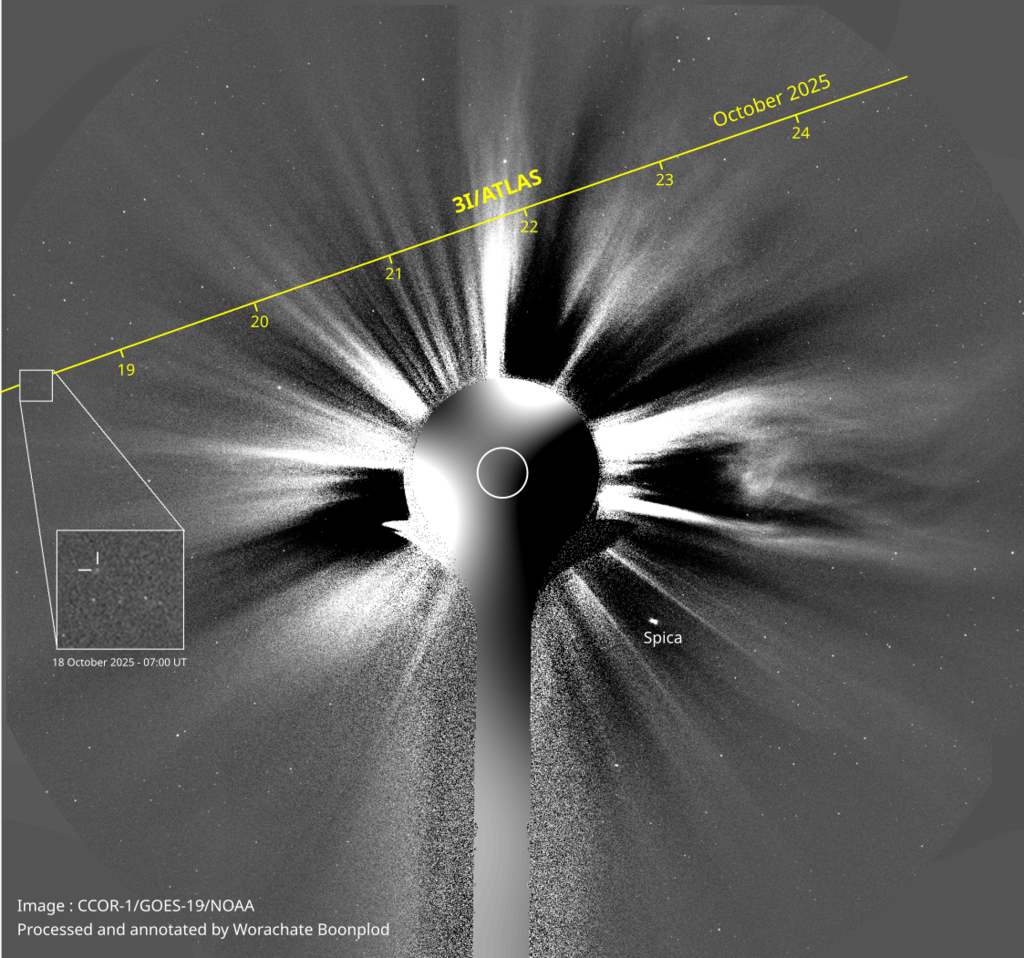
Thai amateur astronomer Worachate Boonplod found the comet in CCOR-1 data
So is NASA's quartet of PUNCH spacecraft, and coronagraphs onboard the Solar and Heliospheric Observatory (SOHO, not far from Earth). Comet 3I/ATLAS is under constant surveillance.
"Unless 3I/ATLAS fades substantially in the next couple of days, we should be able to keep eyeballs on it right through its perihelion (closest approach to the sun)," says coronagraph expert Karl Battams.
Tracking the comet is not easy because it is so faint. Battams explains how it is done: "Objects at the threshold of detection like 3I/ATLAS are a challenge for coronagraphs. We often have to employ image stacking techniques. For this to work, we have to have a very precise understanding of the pointing and distortion of the telescopes so that we can find the exact pixels that correspond to the comet. It gets fiddly, but we make it work."
If 3I/ATLAS changes direction or surges in brightness, we will know. So far, it's acting like a comet. T. Marshall Eubanks from Space Initiatives Inc assembled this light curve, including recent data from CCOR-1 and PUNCH:

These data confirm that 3I/ATLAS is following a fairly standard model of comet brightness with contributions from gas and dust. If this is a spacecraft, it is wearing an uncanny disguise.
In December, 3I/ATLAS will emerge from the glare of the sun. Telescopes on Earth's surface can then rejoin the monitoring effort. Our bet: They will see a comet, not a spaceship. Stay tuned.
Realtime Space Weather Photo Gallery
Free: Spaceweather.com Newsletter
MILKY WAY IN A CRYSTAL BALL: Are you looking for a big gift? How about the entire Milky Way? The students of Earth to Sky Calculus have launched our own galaxy to the stratosphere onboard a cosmic ray research balloon. Here it is 113,517 feet above the Sierra Nevada mountains of central California:

You can have it for $119.95. The galaxy is laser etched inside a 60 mm crystal sphere. You can turn it in your hands, inspecting the spiral star system from any angle. The gift-boxed sphere comes with a greeting card showing the item in flight and telling the story of its journey to the edge of space.
Far Out Gifts: Earth to Sky Store
All sales support hands-on STEM education
Realtime Aurora Photo Gallery
Free: Spaceweather.com Newsletter
| All Sky Fireball Network |
|
On Oct 24, 2025, the network reported 21 fireballs.
(10 sporadics, 5 Orionids, 3 epsilon Geminids, 3 Southern Taurids)
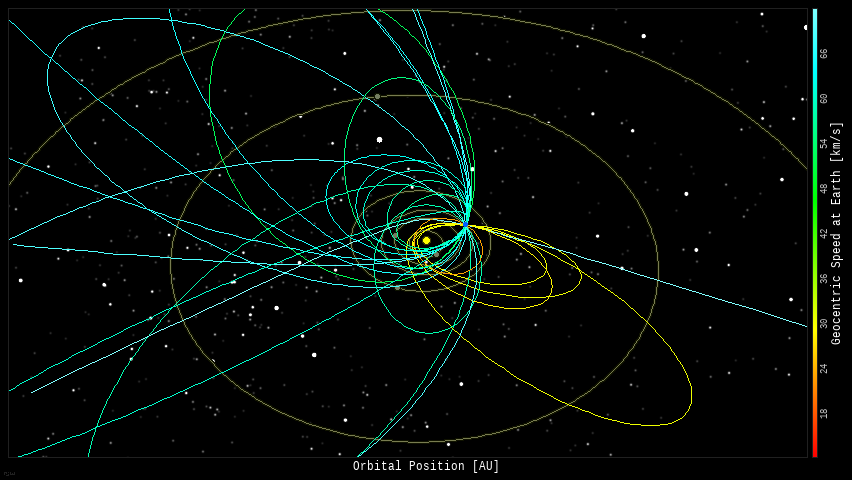
In this diagram of the inner solar system, all of the fireball orbits intersect at a single point--Earth. The orbits are color-coded by velocity, from slow (red) to fast (blue). [Larger image] [movies]
|
| Near Earth Asteroids |
|
|
|
| Asteroid | Date(UT) | Miss Distance | Velocity (km/s) | Diameter (m) |
| 2022 UU15 | 2025-Oct-19 | 14.8 LD | 16.1 | 34 |
| 2025 UL | 2025-Oct-19 | 10.9 LD | 11.9 | 23 |
| 2025 TT10 | 2025-Oct-19 | 1.2 LD | 22.8 | 16 |
| 2025 UO2 | 2025-Oct-19 | 19.2 LD | 8.3 | 22 |
| 2025 UE | 2025-Oct-19 | 13.9 LD | 7.8 | 32 |
| 2025 UW3 | 2025-Oct-20 | 3.8 LD | 8.4 | 7 |
| 2025 TV10 | 2025-Oct-20 | 7.8 LD | 7.2 | 35 |
| 2025 UB2 | 2025-Oct-20 | 19.7 LD | 17 | 51 |
| 2025 TJ11 | 2025-Oct-20 | 7.2 LD | 13.1 | 25 |
| 2025 UR | 2025-Oct-21 | 3.7 LD | 11.6 | 20 |
| 2025 SD7 | 2025-Oct-21 | 9.9 LD | 12.5 | 55 |
| 2025 TQ10 | 2025-Oct-21 | 9.3 LD | 7.4 | 44 |
| 2023 UK3 | 2025-Oct-21 | 6.7 LD | 9 | 5 |
| 2025 UN1 | 2025-Oct-21 | 16.2 LD | 12.6 | 30 |
| 2025 UX | 2025-Oct-21 | 11.9 LD | 6.5 | 21 |
| 2025 TU4 | 2025-Oct-21 | 15.4 LD | 7.7 | 17 |
| 2025 TU10 | 2025-Oct-21 | 15.9 LD | 7.3 | 25 |
| 2025 UA5 | 2025-Oct-21 | 1.4 LD | 5.5 | 8 |
| 2025 UJ4 | 2025-Oct-21 | 0.2 LD | 7.1 | 3 |
| 2025 UJ1 | 2025-Oct-22 | 2.5 LD | 15.3 | 11 |
| 2025 UC2 | 2025-Oct-22 | 0.9 LD | 10.6 | 9 |
| 2025 UB | 2025-Oct-22 | 3.2 LD | 5.4 | 12 |
| 2024 GD2 | 2025-Oct-22 | 17.8 LD | 4.2 | 28 |
| 2025 UV1 | 2025-Oct-22 | 5.5 LD | 11.7 | 21 |
| 2025 UA2 | 2025-Oct-22 | 4.6 LD | 11.3 | 13 |
| 2025 UK2 | 2025-Oct-22 | 13.7 LD | 7.2 | 30 |
| 2025 UE1 | 2025-Oct-22 | 0.7 LD | 15.3 | 17 |
| 2025 TG11 | 2025-Oct-22 | 10.4 LD | 10.8 | 19 |
| 2025 UP1 | 2025-Oct-23 | 18.4 LD | 6.8 | 12 |
| 2025 UH5 | 2025-Oct-23 | 3.5 LD | 9.6 | 14 |
| 2022 HM1 | 2025-Oct-23 | 15.1 LD | 13.3 | 27 |
| 2025 UR3 | 2025-Oct-23 | 1.3 LD | 9.9 | 8 |
| 2025 UE2 | 2025-Oct-23 | 5.9 LD | 9.2 | 11 |
| 2025 UD2 | 2025-Oct-23 | 2.1 LD | 9.6 | 14 |
| 2025 UL1 | 2025-Oct-24 | 9.1 LD | 14.1 | 30 |
| 2025 TX2 | 2025-Oct-24 | 6.3 LD | 6.8 | 26 |
| 2025 UG4 | 2025-Oct-25 | 16.4 LD | 25.8 | 40 |
| 2012 TP231 | 2025-Oct-25 | 15.2 LD | 6.7 | 37 |
| 2025 UX1 | 2025-Oct-25 | 3.6 LD | 14.4 | 10 |
| 2025 UP2 | 2025-Oct-25 | 5.2 LD | 3.1 | 6 |
| 2025 UD3 | 2025-Oct-25 | 1.9 LD | 6.3 | 7 |
| 2025 UU | 2025-Oct-25 | 5 LD | 12.6 | 27 |
| 2025 UJ5 | 2025-Oct-25 | 4.7 LD | 3.3 | 9 |
| 2020 FA5 | 2025-Oct-26 | 15.7 LD | 26.5 | 210 |
| 2025 UU1 | 2025-Oct-26 | 16.1 LD | 13.2 | 26 |
| 2025 UV2 | 2025-Oct-26 | 14.6 LD | 7.7 | 12 |
| 2009 HC | 2025-Oct-26 | 8.6 LD | 4.2 | 39 |
| 2025 UJ2 | 2025-Oct-26 | 18.9 LD | 14.5 | 48 |
| 2025 UF3 | 2025-Oct-27 | 6.2 LD | 3.2 | 14 |
| 434196 | 2025-Oct-27 | 17.4 LD | 10.9 | 171 |
| 2025 UQ1 | 2025-Oct-28 | 10.4 LD | 5.8 | 10 |
| 2025 UD5 | 2025-Oct-29 | 2.5 LD | 3.2 | 20 |
| 2025 UH2 | 2025-Oct-29 | 19.3 LD | 8.9 | 30 |
| 2025 UF5 | 2025-Oct-29 | 2 LD | 3 | 10 |
| 2025 UL2 | 2025-Oct-29 | 3.9 LD | 12.4 | 21 |
| 2025 UF4 | 2025-Oct-30 | 15.3 LD | 10.2 | 78 |
| 2025 TP11 | 2025-Nov-02 | 12 LD | 8.4 | 35 |
| 2005 EZ223 | 2025-Nov-03 | 15.6 LD | 12.9 | 118 |
| 2023 VK6 | 2025-Nov-03 | 7.6 LD | 9.6 | 15 |
| 2025 TB12 | 2025-Nov-04 | 7.3 LD | 6.3 | 21 |
| 2025 UL4 | 2025-Nov-07 | 16.9 LD | 8.2 | 25 |
| 2021 VQ10 | 2025-Nov-08 | 9 LD | 15 | 13 |
| 2019 UH7 | 2025-Nov-08 | 13.3 LD | 5.8 | 11 |
| 2018 KC | 2025-Nov-09 | 16 LD | 9.3 | 11 |
| 2017 WG14 | 2025-Nov-09 | 16.7 LD | 11.7 | 45 |
| 2020 VK4 | 2025-Nov-10 | 16.4 LD | 3.8 | 9 |
| 2012 VC26 | 2025-Nov-11 | 13.3 LD | 6.4 | 6 |
| 2019 VL5 | 2025-Nov-14 | 14.7 LD | 9.1 | 24 |
| 2022 FG4 | 2025-Nov-17 | 18.7 LD | 22.2 | 105 |
| 3361 | 2025-Nov-19 | 14.8 LD | 9.1 | 435 |
| 2013 NJ4 | 2025-Nov-20 | 12.6 LD | 6.4 | 12 |
| 2021 WR | 2025-Nov-22 | 19.3 LD | 10 | 31 |
| 516155 | 2025-Nov-24 | 12.5 LD | 16.7 | 338 |
| 2020 WM | 2025-Nov-24 | 17.4 LD | 11.8 | 36 |
| 2019 UT6 | 2025-Nov-25 | 6.2 LD | 12.6 | 147 |
| 2018 WG2 | 2025-Nov-27 | 13.5 LD | 7.5 | 3 |
| 2007 VM184 | 2025-Dec-01 | 13.1 LD | 20 | 224 |
| 2018 WC2 | 2025-Dec-03 | 9.8 LD | 8.9 | 36 |
| 2021 JE1 | 2025-Dec-08 | 13.5 LD | 7.1 | 16 |
| 2019 XN3 | 2025-Dec-10 | 5.7 LD | 3.6 | 15 |
| 1999 SF10 | 2025-Dec-10 | 8.2 LD | 4.4 | 46 |
| 2016 YH | 2025-Dec-13 | 6.8 LD | 8.9 | 28 |
| 2025 TZ | 2025-Dec-15 | 17.7 LD | 6.2 | 50 |
| 2015 XX168 | 2025-Dec-18 | 4.7 LD | 11.6 | 27 |
| 2010 WR7 | 2025-Dec-20 | 19.5 LD | 8.3 | 71 |
|
|
| Cosmic Rays in the Atmosphere |
|
SPACE WEATHER BALLOON DATA: Almost once a week, Spaceweather.com and the students of Earth to Sky Calculus fly space weather balloons to the stratosphere over California. These balloons are equipped with sensors that detect secondary cosmic rays, a form of radiation from space that can penetrate all the way down to Earth's surface. Our monitoring program has been underway without interruption for 10 years, resulting in a unique dataset of in situ atmospheric measurements.
Latest results (Nov. 2024): Atmospheric radiation is sharply decreasing in 2024. Our latest measurements in November registered a 10-year low:
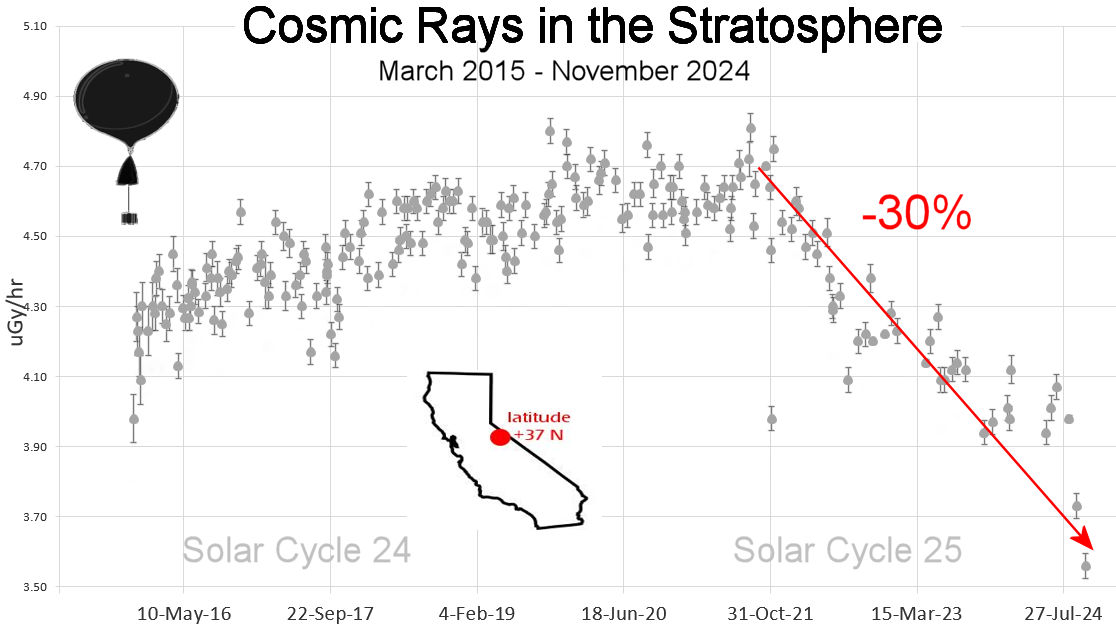
What's going on? Ironically, the radiation drop is caused by increasing solar activity. Solar Cycle 25 has roared to life faster than forecasters expected. The sun's strengthening and increasingly tangled magnetic field repels cosmic rays from deep space. In addition, solar coronal mass ejections (CMEs) sweep aside cosmic rays, causing sharp reductions called "Forbush Decreases." The two effects blend together to bring daily radiation levels down.
.Who cares? Cosmic rays are a surprisingly "down to Earth" form of space weather. They can alter the chemistry of the atmosphere, trigger lightning, and penetrate commercial airplanes. According to a study from the Harvard T.H. Chan school of public health, crews of aircraft have higher rates of cancer than the general population. The researchers listed cosmic rays, irregular sleep habits, and chemical contaminants as leading risk factors. A number of controversial studies (#1, #2, #3, #4) go even further, linking cosmic rays with cardiac arrhythmias and sudden cardiac death.
Technical notes: The radiation sensors onboard our helium balloons detect X-rays and gamma-rays in the energy range 10 keV to 20 MeV. These energies span the range of medical X-ray machines and airport security scanners.
Data points in the graph labeled "Stratospheric Radiation" correspond to the peak of the Regener-Pfotzer maximum, which lies about 67,000 feet above central California. When cosmic rays crash into Earth's atmosphere, they produce a spray of secondary particles that is most intense at the entrance to the stratosphere. Physicists Eric Regener and Georg Pfotzer discovered the maximum using balloons in the 1930s and it is what we are measuring today.
|
| Essential web links |
|
 | NOAA Space Weather Prediction Center |
|
| The official U.S. government space weather bureau |
|
| Atmospheric Optics |
|
| The first place to look for information about sundogs, pillars, rainbows and related phenomena. |
|
| Solar Dynamics Observatory |
|
| Researchers call it a "Hubble for the sun." SDO is the most advanced solar observatory ever. |
|
| STEREO |
|
| 3D views of the sun from NASA's Solar and Terrestrial Relations Observatory |
|
| Solar and Heliospheric Observatory |
|
| Realtime and archival images of the Sun from SOHO. |
| SolarMonitor.org |
|
| information about sunspots based on the latest NOAA/USAF Active Region Summary |
|
| Starlink Satellite Statistics |
|
| current counts of failed and deployed Starlink satellites from Jonathan's Space Page. See also, all satellite statistics. |
|
| The Aerospace Corporation |
|
| Authoritative predictions of space junk and satellite re-entries |
|
| Daily Sunspot Summaries |
|
| from the NOAA Space Environment Center |
|
| NOAA 27-Day Space Weather Forecasts |
|
| fun to read, but should be taken with a grain of salt! Forecasts looking ahead more than a few days are often wrong. |
| Aurora 30 min forecast |
|
| from the NOAA Space Environment Center |
| Live Aurora Webcam |
|
| from Lights over Lapland |
| Heliophysics |
|
| the underlying science of space weather |
| Spaceweather.com welcomes these supporters of science communication: AI SEO Agency and SEO agency and roofers and roofing contractors in South Jerseyand commercial cleaning in Phoenix and Peoria AZ | Pest Control in Phoenix | HVAC repair in South Jersey | Dental implants New Jersey | dentist in Ahwatukee |
| To get the best views of the cosmos, check out the Phoenix Window Glass Replacement experts for all your window and glass needs |
|
| Got a chipped or cracked windshield that prevents you from seeing space weather events while driving? Get windshield replacement from SR Windows & Glass with free mobile auto glass service anywhere in the Phoenix area. |
| NASA Near Earth Asteroid Home Page |
| Chicago SEO Expert |
| Search Kelowna Real Estate Listings & Homes for Sale easily. Find help on all Calgary Homes For Sale and Real Estate Listings. Great source for Edmonton Real Estate Listings & Homes For Sale |
|
| These links help Spaceweather.com stay online. Thank you to our supporters! |
|
AQUÍ El tailandés escurridizo y que husmeando en el CORONOGRAFO (pensé era el CRONOVISOR del Vaticano donde supuestamente ven el pasado de la humanidad)... jeje encontró al también escurridizo amigo cometa atlas... Bueno pues dejo los sitios donde ustedes pueden rastrear al cometa susodicho:... ahh!- no vayan a creer de verdad este cuate es el auténtico tailandés jaja...  | more links... FUENTE |

https://www.swpc.noaa.gov/products/coronagraph
https://science.nasa.gov/?search=Worachate+Boonplod
Un cometa recién descubierto fue visto durante el eclipse solar total
El aficionado astrónomo Worachate Boonplod descubrió el cometa el domingo 13. Sabía que se acercaba el eclipse y estaba ansioso por ver si su nuevo descubrimiento podría aparecer en la atmósfera exterior del Sol.

Y como ya no quiero confundirlos con mas enlaces mejor aqui queda por lo pronto.
vayan también aqui:
EN LA MIRA... TE ESTAMOS VIENDO...

SIGUE AQUÍ AL COMETA ATLAS 31



No hay comentarios.:
Publicar un comentario